
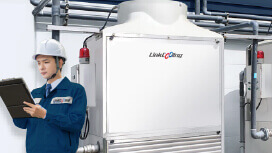

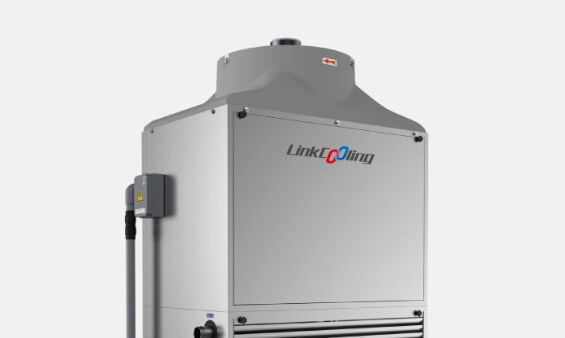
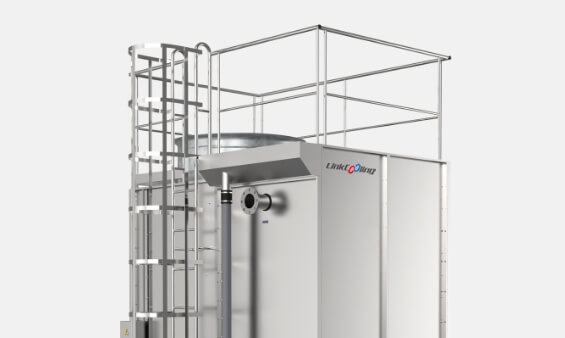
As the “lungs” of a cooling system, the fill (heat-dissipation media) directly determines overall heat-exchange efficiency and system reliability. Traditional PVC fills are limited by material characteristics—they become brittle and fail under thermal stress and UV exposure, turning into a continuous consumable and a persistent reliability weak point. Linkcooling reengineered the fill from the perspectives of material science and system architecture, creating a sustainable heat-dissipation solution built on high-performance engineering plastics and a bionic honeycomb structure. This is not just a component upgrade—it is a Design for Maintainability system embedded with ESG principles, engineered to eliminate long-standing maintenance issues and environmental costs.
Core Technology
Linkcooling’s SustainFin Technology transforms the traditional role of cooling-tower fill across architecture, materials, and structural design—upgrading it from a “consumable” to a “sustainable asset.”
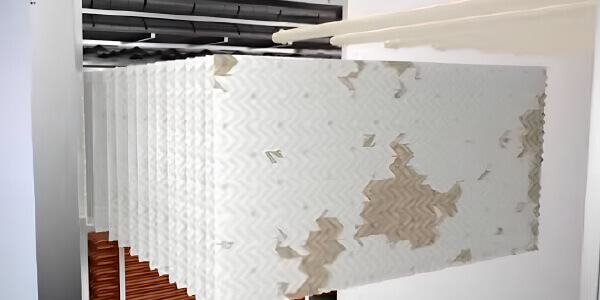
Modular Design & Maintenance Revolution
-
Maintainability-Centric Architecture: A modular, removable design allows each fill block to be individually extracted instead of acting as a fixed internal structure. This enables online maintenance—cleaning or replacing a single module without shutting down the system—ensuring uninterrupted operation.
-
Driving the Circular Economy: Circularity is embedded from the beginning of the product lifecycle, enabling a zero-waste maintenance model. The fill transitions from a “consumable” into a permanent asset.
High-Performance ABS Engineering Plastics

-
Breakthrough Material Performance Beyond PVC: Manufactured using 100% virgin ABS engineering plastic, never recycled content. Its high heat-distortion resistance withstands pressure washing and long-term thermal stress, eliminating brittleness and cracking commonly seen in PVC. The material’s toughness, impact resistance, and long-term durability ensure the fill becomes a stable, long-lasting functional component instead of a consumable.
-
Engineering-Grade Durability: Exceptional toughness allows the fill to endure high-pressure cleaning and mechanical stress, enabling
rather than one-time use.
Structural Optimization & Multi-Function Integration
Linkcooling provides two structural variants—Honeycomb and Waveform—each engineered to maximize cooling performance and maintenance convenience for different industries.
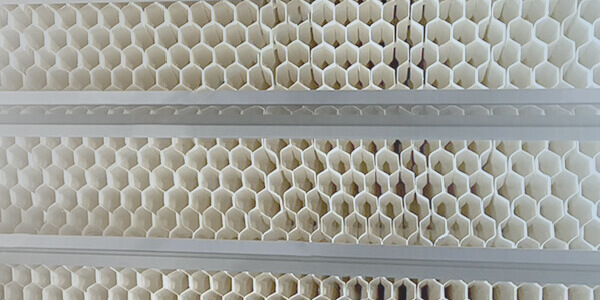
Honeycomb Structure
Inspired by natural bionics, the honeycomb structure delivers optimized material efficiency and fluid distribution. Its large surface area and guided flow pathways enhance heat-exchange dwell time and ensure uniform air-water contact.
With exceptional structural strength and long-term durability, the honeycomb design is ideal for semiconductor, pharmaceutical, and precision-manufacturing applications requiring tight temperature stability.
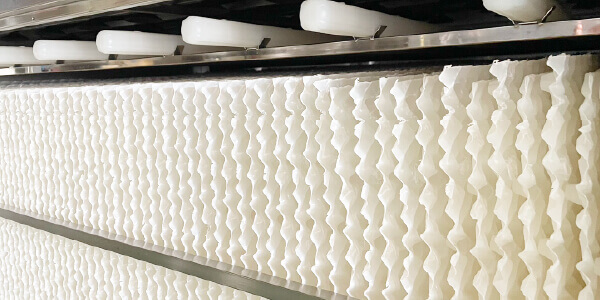
Waveform Structure
Designed for optimized water distribution and maximized heat exchange. The engineered surface texture disturbs laminar flow, enhancing thermal transfer while reducing short-circuiting and stagnant water zones.
Its strong anti-fouling behavior and easy-maintenance characteristics minimize scale formation and biological growth—ideal for industries such as injection molding and metal processing that demand both efficiency and stability.
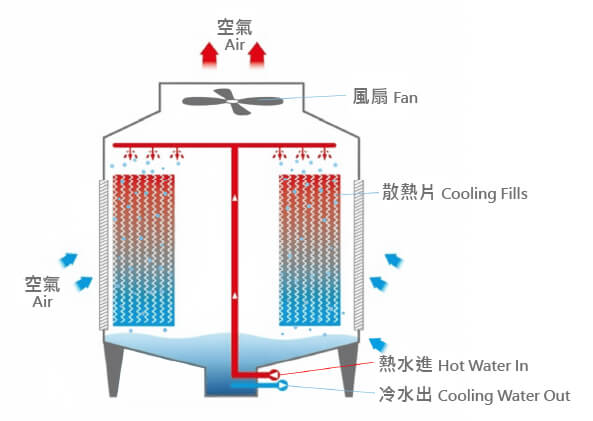
At the heart of every cooling tower is efficient heat dissipation, and the design and material quality of the fill are among the most critical factors determining performance, lifetime, and ease of maintenance. Key functions include:
-
Increasing water–air contact surface area
-
Extending heat-exchange dwell time
-
Ensuring uniform water distribution
A well-designed fill significantly enhances cooling efficiency and reduces fan power consumption. Traditional PVC fills, however, degrade quickly under heat and long-term operation—becoming brittle, clogging water paths, fostering bacteria growth, and requiring frequent replacement.
Linkcooling’s SustainFin Technology represents a system-level engineering breakthrough. Through innovations in material science, structural design, and modular architecture, it transforms a traditional maintenance bottleneck into an advantage in reliability and sustainability—marking a paradigm shift from “consumable-type” to “sustainable-type” cooling technology.