Linkcooling Product Philosophy

Rooted in Taiwan, delivering cooling solutions worldwide.

Linkcooling Product Philosophy
icon

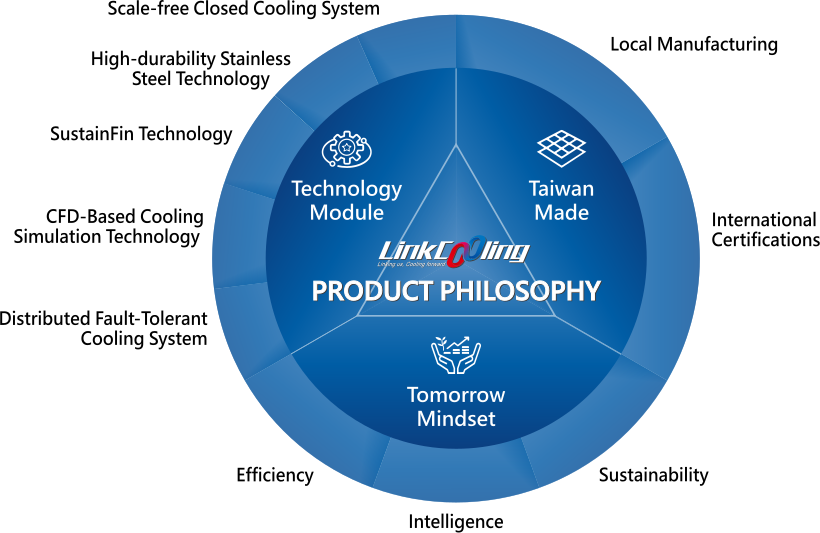
Linkcooling is dedicated to providing cooling system solutions across a wide range of industries, carrying forward the precision craftsmanship and quality excellence of Taiwan manufacturing. By integrating innovative modular technology with our core brand philosophy, we deliver high-efficiency, intelligent, and sustainable cooling solutions to customers around the world.

We firmly believe that every innovation—from the smallest detail to the entire system architecture—has the power to bring greater stability and efficiency to global industries. Together with our partners worldwide, we are driving the future of industrial cooling.

Taiwan Made - Crafted in Taiwan
01
Crafted in Taiwan
Taiwan Made

Combining precision manufacturing, international certification, rapid customization, and comprehensive after-sales service, we established a dedicated CTI-certified international testing facility to deliver cooling solutions that are more efficient, more energy-saving, and more environmentally sustainable for industries.

Technology Module - Core Technologies
02
Core Technologies
Technology Module

The Five Core Technology Modules of Linkcooling are built upon sustainability, high-efficiency design, and user convenience—delivering the most reliable cooling solutions for modern industries.

Tomorrow Mindset - Core Philosophy
03
Core Philosophy
Tomorrow Mindset

With a future-forward mindset, we work alongside our customers—from needs discovery and design development to installation and maintenance—thinking together, creating together, and progressing together to achieve a shared vision of efficiency, intelligence, and sustainability.

TM
01
icon
Taiwan Made
icon
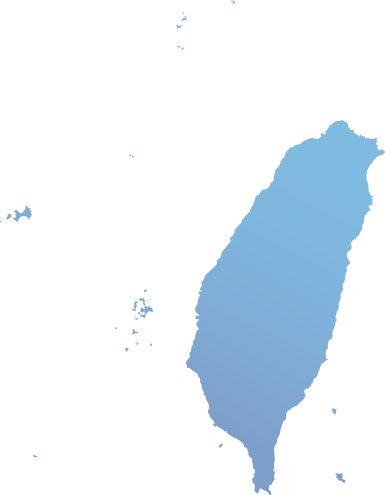
Taiwan map illustration

Crafted in Taiwan

Made in Taiwan is not just quality — it is an attitude.

Linkcooling inherits Taiwan’s precision craftsmanship and commitment to quality. With rigorous quality control, every step—from manufacturing to performance testing—is completed in-house, ensuring that each cooling system is ready for installation the moment it leaves our factory.

Taiwanese manufacturing combines precision processes, international certifications, rapid customization, and comprehensive after-sales service, giving our cooling systems global competitiveness in durability, efficiency, and market adaptability.
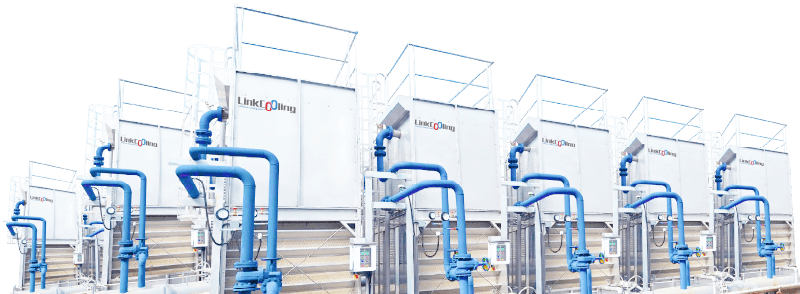
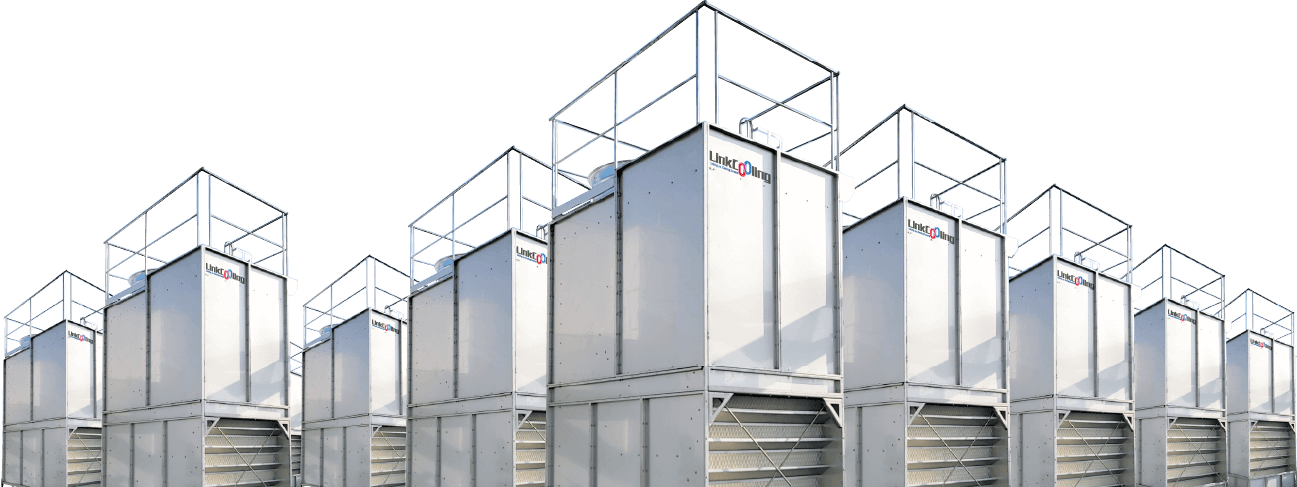
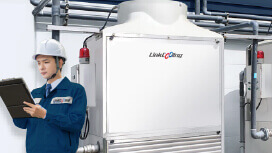
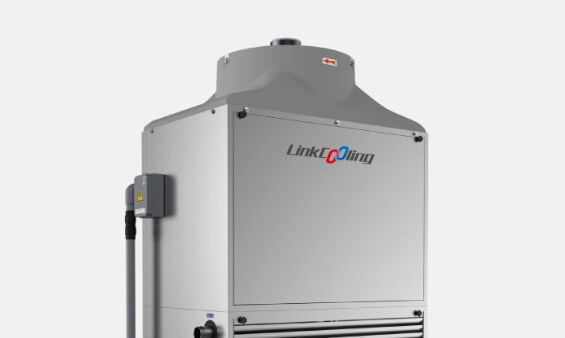
Linkcooling product image

Precision Manufacturing

Rigorous processes and precise craftsmanship ensure each cooling system operates efficiently and reliably, with a lifespan exceeding 30 years.

Rapid Customization

With extensive export experience and strong familiarity with regulatory standards across North America, Europe, and Asia (including CTI, CE, IE ratings), we quickly adapt designs to local environments and customer-specific requirements.

Comprehensive Service & Technical Support

Linkcooling keeps component production, manufacturing facilities, and R&D teams centralized within Taiwan’s complete supply chain. This shortens development and delivery schedules, while ensuring fast response and immediate support for after-sales needs.

International Certification & Taiwan CTI Test Facility

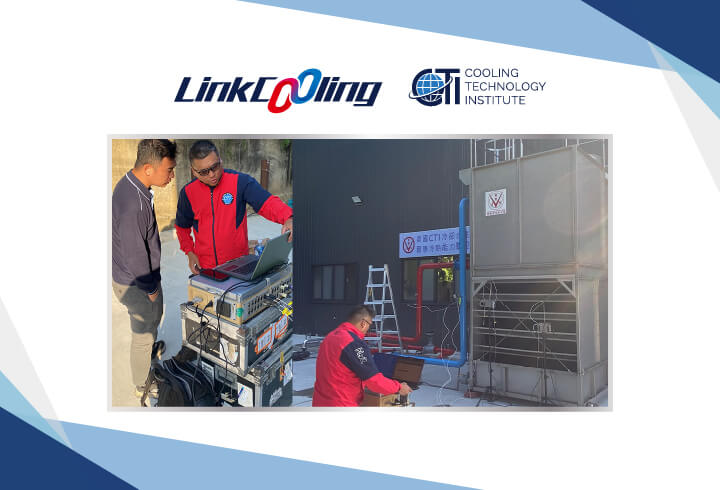
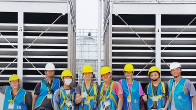
Linkcooling International CTI Test Facility

Leveraging advanced engineering capabilities, Linkcooling™ has successfully obtained international CTI (Cooling Technology Institute) certification and invested tens of millions of NTD to establish a dedicated CTI-certified test facility in Taiwan. As one of the few companies in Taiwan with this accreditation, it demonstrates not only that our products pass the highest global performance standards, but also the industry’s strong trust in Linkcooling quality and technology.

CTI Certification | Dual Assurance of Quality & Market Competitiveness

CTI accreditation validates the exceptional cooling performance of Linkcooling™ products and significantly enhances their competitiveness in global markets. We are committed to delivering highly efficient, energy-saving, and environmentally friendly cooling solutions—empowering enterprises to achieve operational excellence and sustainable development.

The HCT-J Series has passed the strict CTI performance test, achieving an outstanding 110% cooling efficiency. In high-load applications such as AI servers and heavy industrial manufacturing, it delivers remarkable stability, energy savings, and operational reliability, ensuring enterprises can reduce energy consumption, enhance efficiency, and optimize production processes.

CTI Certification Facility — Linkcooling Taiwan
Linkcooling Technology Module Linkcooling Technology Module
Linkcooling Technology Module
icon
TM
02

Core Technology

Linkcooling™ builds on Jin Hui’s 30 years of cooling-tower manufacturing expertise, crafted specifically for the global market. With a core philosophy of sustainability, high-efficiency design, and user convenience, we transform technological innovation into real-world performance, delivering the most reliable cooling solutions for modern industries.

Driven by this philosophy, we developed our Five Core Technology Modules—a holistic framework that elevates cooling performance and long-term equipment durability.
Scale-free Closed Cooling System

Eliminating Scaling at the Source for Long-Term Thermal Stability

Built on Linkcooling’s fully closed dual-circulation architecture, combined with thermofluid design and a modular system framework, the Scale-free Closed Cooling System fundamentally eliminates the traditional issues of scaling, corrosion, and biological growth caused by evaporative concentration and environmental contamination in conventional open cooling towers.

In open cooling systems, water quality continuously deteriorates during operation, causing heat exchange efficiency to drop by 10–15% annually on average. The resulting chemical dosing, downtime losses, and manpower overhead lead to significant recurring costs. Linkcooling applies two core technologies — “complete isolation of internal and external water” and “extreme water quality management” — reducing scaling risk to near zero and lowering water treatment costs by 90%, while safeguarding long-term equipment performance and operational stability.

This design is especially suited for industries that demand exceptionally clean cooling water, such as semiconductors, precision manufacturing, plastics & rubber, and metal processing, delivering reliable, high-efficiency and low-maintenance thermal management solutions.

System Architecture

Primary loop closed circuit cooling system illustration
Primary Loop (Internal Coil Circuit)

The fully enclosed primary circuit circulates heated water inside the coil without evaporation or contamination, ensuring long-term purity and stability. With no concentration increase and zero scaling formation, the system maintains optimal heat transfer efficiency and significantly extends equipment life.

External sprinkler cooling loop illustration
Secondary Loop (External Sprinkler System)

Water drawn from the cold-water basin is sprayed over the heat-exchange coils and fill, then returned for reuse. This loop manages only heat dissipation and does not enter the internal circuit, isolating impurities, algae, and scaling risks entirely.

Operating Principle

Dual-Circuit Independent Heat-Exchange Architecture

The system adopts a fully isolated dual-circulation structure, eliminating cross-contamination and preventing all water-quality degradation pathways at the source.

Primary internal circulation diagram for closed cooling system

Primary Loop (Internal / Process Circuit)
  • Working Medium: purified water, soft water, tap water, or dedicated coolant.

  • Cycle Path: circulates within the fully closed coil heat exchanger and exchanges heat with customer equipment (e.g., injection molding machine heat exchangers, furnaces). Heat is removed through evaporative cooling when the external loop sprays water across the coil surface. Drift water returns to the basin for reuse.

  • Core Value: the internal loop remains permanently clean, concentration stays constant, zero evaporation loss, and scaling/corrosion/algae conditions are physically eliminated — preserving equipment life and thermal efficiency.

Secondary external cooling circuit diagram

Secondary Loop (External / Heat Dissipation Circuit)
  • Working Medium: conventional cooling water exposed to ambient air.

  • Cycle Path: external water is evenly sprayed over the heat exchanger surface, removing heat via evaporation. Drift water collects in the basin and is reused.

  • Core Value: this loop absorbs all impurities and environmental stress as a sacrificial cycle, keeping the internal loop absolutely clean. Its water degradation does not affect cooling efficiency.

Technical Features

  • 90% Reduction in Water Treatment Costs: complete separation of internal/external water eliminates the need for chemicals in the primary loop.

  • Core Equipment Protection: prevents scaling and corrosion in process heat exchangers, avoiding chemical cleaning damage and reducing downtime.

  • Sustained Thermal Performance: no scaling means temperature stability over years of operation.

  • Modular Components: pumps, piping, and coils are modular for easy maintenance and upgrades.

  • Productivity & Performance Boost: ideal for injection molding, semiconductor, and metal-processing industries requiring stable thermal conditions.

Through complete “dual-loop isolation” and “fully closed water-quality management,” Linkcooling delivers a cooling solution that is not only efficient but also low-maintenance, long-life, and environmentally sustainable.

BACK

High-durability Stainless Steel Technology

Engineered from the Ground Up for a Minimum 10-Year Service Life

Linkcooling follows a sustainability-first philosophy, equipping all series with 304 stainless steel enclosures as a standard—not an upgrade. Its exceptional corrosion and weather resistance ensure long-term stable operation, maintaining peak performance even in harsh environments.

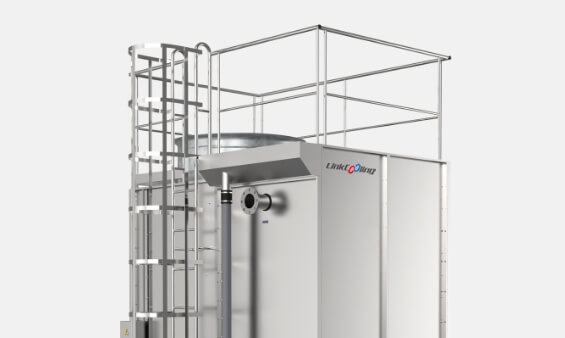
Linkcooling stainless steel housing designed for harsh industrial environments

We redefine traditional structural design with our support-free bending technology, replacing internal frames and screws with precision-formed stainless steel panels to create a more robust structural system. This engineering approach significantly reduces joints and loosening risks, delivers strong resistance to vibration and wind loads, extends equipment lifespan, and lowers maintenance or downtime caused by corrosion and structural degradation.

Linkcooling’s stainless steel structure is not “added on” — it is engineered from the inside out. The structure is not merely supported — it is inherently stable.

Support-free bent stainless steel structure for enhanced stability and durability

Structurally Unshakable — Zero Downtime for Production

Backed by structural simulation and engineering analysis, the system withstands earthquakes, strong winds, and operational micro-vibrations without transferring undue stress to the building—ideal for rooftop and multi-story installations. Its folded stainless-steel body resists salt corrosion, acid rain, strong winds, and seismic activity, and delivers:

  • Longer lifespan: corrosion- and vibration-resistant, minimizing equipment replacement.

  • Lower maintenance costs: fewer joints and solid construction reduce loosening or leakage issues.

  • Higher operational stability: maintains performance under extreme weather and heavy load, preventing production interruptions.

Design Highlights

  1. Fully detachable stainless steel panels: enabling easy inspection and maintenance.

  2. One-piece stainless steel water basin: seamless, leak-free, and optimized for drainage.

  3. Acid-washable stainless steel coils: durable, easy to clean; copper coils optional.

  4. Modular single-tube coil replacement: flexible maintenance and freeze-resistant design (exclusive to the SCT Series).

Technical Value

  1. Lower Total Cost of Ownership (TCO): though the initial cost is higher, maintenance is significantly reduced, lifespan extended, and ROI improved within 5 years.

  2. Reduced downtime risks: corrosion-free structure minimizes unexpected failures and production loss.

  3. Enhanced corporate image: high-grade, eco-friendly materials support ESG goals and reflect a strong commitment to sustainability.

Material Characteristics

  1. Material assurance: 304 stainless steel (18% Cr + 8% Ni) provides outstanding oxidation and corrosion resistance—lasting up to 3× longer than carbon steel.

  2. Proven durability: passed long-duration acid-wash tests, ensuring stability in harsh environments without coating delamination issues.

  3. Global applicability: widely adopted in semiconductor, pharmaceutical, and precision manufacturing industries, trusted by international clients.

  4. Taiwan-certified seismic design: meets Level-6 earthquake resistance standards.

Core Features

  1. Superior corrosion resistance: engineered to withstand acidic water, hard water, and industrial fumes.

  2. High structural durability: compared to carbon steel or galvanized steel, 304 stainless steel retains structural strength for 10+ years without rusting or deformation.

  3. Low maintenance cost: no coatings or linings required, reducing maintenance costs by 30–50%.

  4. Environmentally friendly and 100% recyclable: meeting ESG sustainability standards.

BACK

SustainFin Technology

A Next-Generation Solution Built on Material Science and Modular Architecture

As the “lungs” of a cooling system, the fill (heat-dissipation media) directly determines overall heat-exchange efficiency and system reliability. Traditional PVC fills are limited by material characteristics—they become brittle and fail under thermal stress and UV exposure, turning into a continuous consumable and a persistent reliability weak point. Linkcooling reengineered the fill from the perspectives of material science and system architecture, creating a sustainable heat-dissipation solution built on high-performance engineering plastics and a bionic honeycomb structure. This is not just a component upgrade—it is a Design for Maintainability system embedded with ESG principles, engineered to eliminate long-standing maintenance issues and environmental costs.

Core Technology

System-Level Innovation Across Three Dimensions

Linkcooling’s SustainFin Technology transforms the traditional role of cooling-tower fill across architecture, materials, and structural design—upgrading it from a “consumable” to a “sustainable asset.”

Modular removable fill system for sustainable cooling tower maintenance

Modular Design & Maintenance Revolution
  • Maintainability-Centric Architecture: A modular, removable design allows each fill block to be individually extracted instead of acting as a fixed internal structure. This enables online maintenance—cleaning or replacing a single module without shutting down the system—ensuring uninterrupted operation.

  • Driving the Circular Economy: Circularity is embedded from the beginning of the product lifecycle, enabling a zero-waste maintenance model. The fill transitions from a “consumable” into a permanent asset.

High-Performance ABS Engineering Plastics

Virgin ABS engineering plastic fill material for durability and heat resistance

  • Breakthrough Material Performance Beyond PVC: Manufactured using 100% virgin ABS engineering plastic, never recycled content. Its high heat-distortion resistance withstands pressure washing and long-term thermal stress, eliminating brittleness and cracking commonly seen in PVC. The material’s toughness, impact resistance, and long-term durability ensure the fill becomes a stable, long-lasting functional component instead of a consumable.

  • Engineering-Grade Durability: Exceptional toughness allows the fill to endure high-pressure cleaning and mechanical stress, enabling rather than one-time use.

Structural Optimization & Multi-Function Integration

Linkcooling provides two structural variants—Honeycomb and Waveform—each engineered to maximize cooling performance and maintenance convenience for different industries.

Bionic honeycomb cooling tower fill for high thermal efficiency and stability

Honeycomb Structure

Inspired by natural bionics, the honeycomb structure delivers optimized material efficiency and fluid distribution. Its large surface area and guided flow pathways enhance heat-exchange dwell time and ensure uniform air-water contact.

With exceptional structural strength and long-term durability, the honeycomb design is ideal for semiconductor, pharmaceutical, and precision-manufacturing applications requiring tight temperature stability.

Waveform fill structure for anti-fouling, easy maintenance, and enhanced heat exchange

Waveform Structure

Designed for optimized water distribution and maximized heat exchange. The engineered surface texture disturbs laminar flow, enhancing thermal transfer while reducing short-circuiting and stagnant water zones.

Its strong anti-fouling behavior and easy-maintenance characteristics minimize scale formation and biological growth—ideal for industries such as injection molding and metal processing that demand both efficiency and stability.

At the heart of every cooling tower is efficient heat dissipation, and the design and material quality of the fill are among the most critical factors determining performance, lifetime, and ease of maintenance. Key functions include:

  • Increasing water–air contact surface area

  • Extending heat-exchange dwell time

  • Ensuring uniform water distribution

A well-designed fill significantly enhances cooling efficiency and reduces fan power consumption. Traditional PVC fills, however, degrade quickly under heat and long-term operation—becoming brittle, clogging water paths, fostering bacteria growth, and requiring frequent replacement.

Traditional PVC fill comparison with Linkcooling sustainable engineering plastic fill

Linkcooling’s SustainFin Technology represents a system-level engineering breakthrough. Through innovations in material science, structural design, and modular architecture, it transforms a traditional maintenance bottleneck into an advantage in reliability and sustainability—marking a paradigm shift from “consumable-type” to “sustainable-type” cooling technology.

BACK

CFD-Based Cooling Simulation Technology

CFD simulation + CTI validation for true performance accuracy.

Traditional cooling tower design relies heavily on empirical rules and simplified formulas, making it difficult to accurately predict the complex fluid behaviors that occur during real-world operation. This often leads to discrepancies in energy consumption, water loss, and cooling performance. Linkcooling integrates advanced Computational Fluid Dynamics (CFD) simulation with authoritative CTI physical performance certification, enabling virtual validation and optimization of every detail during the design stage. This ensures that actual system performance approaches the “ideal value” rather than remaining only a theoretical estimate—delivering precise, efficient, and sustainable cooling solutions.

Dual Assurance from Virtual Simulation to Physical Validation

By combining CFD simulation software with CTI international performance certification, Linkcooling establishes a dual-layer reliability framework. This ensures that every cooling unit consistently delivers stable, above-standard cooling performance.

CFD Software Simulation (Virtual Validation)

Using advanced digital modeling technology, a 3D model of the cooling tower is created to simulate complex internal behaviors such as airflow, water flow, heat exchange, and drift behavior, identifying and resolving design blind spots in advance.

  • Create a 3D cooling tower model to simulate airflow, water flow, heat exchange, and drift phenomena.

  • Identify and correct potential design weaknesses early.

  • Convert simulation data into manufacturing standards to enhance product consistency.

CFD pipe pressure-loss simulation for cooling tower optimization

Pipe Pressure-Loss CFD Simulation

CTI Performance Certification (Physical Validation)

Finalized designs are submitted to laboratories certified by the Cooling Technology Institute (CTI) for rigorous testing. Key indicators such as cooling capacity, water loss, and power consumption must not only meet but often exceed international standards (with certified performance reaching up to 110%). This provides objective and authoritative validation of system performance.

  • Certified through stringent CTI laboratory testing.

  • Cooling efficiency, water consumption, and energy-use metrics fully verified.

  • Certified efficiency up to 110%, delivering validated high performance.

CFD airflow and thermal field analysis for cooling tower optimization

Cooling Field Simulation Analysis

Co-directional Air–Water Flow & Hybrid Flow System

Through CFD simulation, Linkcooling applies co-directional airflow and water flow and a hybrid flow design to achieve physical performance breakthroughs:

  • Physical Separation of Fills and Coils:

    Air (airflow) and water (spray water) operate independently, eliminating mutual interference and preventing airflow resistance from disrupting water distribution.

  • Co-directional Spray Water Adhering to Coils:

    Guided airflow helps water evenly adhere to coil surfaces, reducing dry spots and lowering external coil scaling by 3–10%, while doubling the effective heat-exchange surface area.

  • Quick-detach Spray Pipes & Drift Control System:

    Based on simulation optimization, quick-detach spray components and efficient drift eliminators reduce over 90% of drift losses, saving water and lowering maintenance costs.

Hybrid airflow and water-flow system simulation diagram

CFD drift elimination optimization diagram

CFD water distribution optimization illustration

Technical Applications

Simulation Optimization Focus Problems Resolved in Traditional Systems Value & Benefits
Airflow & Flow-field Optimization Uneven airflow distribution and short-circuit recirculation reduce heat-exchange efficiency.
  • Improved cooling performance

  • Reduced fan energy consumption

  • Ensures complete airflow coverage of heat-exchange areas

Uniform Spray-water Distribution Uneven spray causes coil dry spots, severe efficiency loss, and excessive scaling.
  • 3–10% reduction in external coil scaling

  • Eliminates dry spots for consistent performance

  • Maximizes coil wetting and coverage

Internal Coil Flow Resistance & Pressure Drop Optimization Poor pipe design leads to unbalanced flow distribution, weak terminal heat exchange, and excessive internal pressure loss.
  • More accurate pump selection, lowering power consumption

  • Balanced heat exchange across all coil zones

  • Improved overall system efficiency

Water-loss Control & Drift Prevention Severe drift loss wastes water and affects the surrounding environment.
  • Reduces drift loss by over 90%

  • Saves water and lowers chemical treatment costs

  • Supports ESG compliance and sustainable operation

Linkcooling’s CFD-Based Cooling Simulation Technology ensures stable and non-degrading cooling performance through combined CTI + CFD validation. Users benefit from longer equipment life, lower maintenance costs, and ESG-aligned reductions in energy and water usage—making it ideal for industries demanding extreme reliability and efficiency, maximizing the return on every unit of energy invested.

BACK

Distributed Fault-Tolerant Cooling System

M+1 Redundant Resource Pool Architecture — Engineered for Continuous, Uninterrupted Production

On-demand expansion and real-time fault tolerance, delivering 24/7 uninterrupted stability for mission-critical processes across industries.

To solve the rigidity and single-point-of-failure risks of traditional large monolithic cooling systems, Linkcooling pioneered the Distributed Fault-Tolerant Cooling System. This architecture decomposes total cooling demand into multiple intelligently coordinated, standardized modules, and through the top-level design of flexible module configuration (M Modules) and fault-tolerant redundancy (+1), it creates a next-generation cooling infrastructure with no single point of failure, online scalability, and maintainability—delivering high availability and optimized total cost of ownership (TCO) for customers worldwide.

Overview diagram of Linkcooling distributed M+1 fault-tolerant cooling system architecture

From Design Concept to Real-World Engineering Practice

M+1 Fault-Tolerant and Expandable Resource Pool Architecture

Linkcooling designs redundancy and expansion capability as a dynamically orchestrated resource pool, fully embodying the ultimate system intent. The core concept:

  • “M” – Number of Modules: “M” represents the number of modules required to satisfy the current base load (number of Modules), and also the modules that can be paralleled and added at any time to support capacity growth, enabling painless scaling. Just like adding compute resources in a cloud environment, you can horizontally scale cooling capacity (Scale-out) on demand—perfectly matching production fluctuation and expansion plans.

  • “+1” – Fault-Tolerant Standby: “+1” is a dedicated fault-tolerant failover module that remains in hot-standby. Whenever any online module fails or needs maintenance, this standby unit takes over instantly and seamlessly, ensuring high availability. “+1” is not merely a spare unit—it is part of an intelligent resource scheduling system.

Schematic of Linkcooling M+1 fault-tolerant cooling resource pool architecture

We fully implement the design principle of “online maintenance with fault-tolerant operation.” Each cooling module is a self-contained, independent unit, so its operation, maintenance, and failure are confined to a single zone and do not create ripple effects across the entire system.

  • Predictive Maintenance in Practice: The system supports planned rotational maintenance schedules, automatically offlining specific modules for service while the standby module takes over seamlessly—achieving true zero-touch maintenance and ensuring continuous production.

  • Operator Safety and Ergonomic Design: Generous maintenance aisles and quick-release structures are designed into the system from day one. This is not just about convenience—it is an engineering-level guarantee of safety and efficiency for operations and maintenance personnel.

On-site view of Linkcooling modular cooling units with wide maintenance access aisle

Intelligent Cluster Control

Depending on customer needs, Linkcooling can help design an intelligent cluster control architecture that covers the entire production line and its cooling system. The core rotation and scheduling logic dynamically adjusts the number of running modules to match the cooling load, and supports maintenance scheduling modes to ensure that even when some modules are offline, standby units can take over without disruption.

Unlike traditional single-unit control, intelligent cluster control is not a fixed standard feature but a tailored integrated solution—allowing customers to opt into a more advanced, intelligent operating mode when required.

System Installation & Maintenance

With Rapid Deployment & Just-in-Time Supply Design as the core philosophy, Linkcooling turns potential risks into manageable factors, ensuring high efficiency and high reliability throughout the entire lifecycle—from installation to long-term maintenance.

Factory pre-assembly of Linkcooling modular cooling units before shipment

Pre-assembled:

Over 90% of system assembly and testing is completed at the factory, significantly reducing uncertainty during on-site construction and shortening installation time. This model is especially suited for overseas projects, enabling customers to achieve stable capacity in the shortest possible time.

Standardized modular cooling components for interchangeable M+1 architecture

Modular & Standardized Architecture

Core components (fans, pumps, motors, control units) adopt unified specifications across the system, achieving full interchangeability and interoperability so that replacement or expansion resources are always available—wherever the system is deployed.

Design Value in Practice:

  • Near-zero spare-parts inventory cost: A single spare part can support the entire system. Linkcooling simplifies complex spare-parts inventory management into a “one-to-many” model, dramatically reducing total cost of ownership (TCO), and ensuring global sites can be supplied just in time—eliminating the operational risk of stockouts at remote locations.

  • Maintenance-efficiency revolution: Frontline personnel no longer need to identify numerous variants, greatly shortening troubleshooting and repair time and improving the Mean Time to Repair (MTTR) index.

Extreme-Environment Engineering & Space Optimization

Our engineering design is based on a “global applicability” standard. The main structure uses AISI 304 stainless steel, offering significantly higher durability than traditional FRP and far better corrosion resistance than conventional steel. It can withstand extreme environments ranging from desert high-temperature zones to coastal industrial areas, providing a material foundation for a system lifetime of 30 years.

Design Highlights:

  • Invisible space integration: A unique narrow-profile modular design enables linear, L-shaped, and other layout patterns, integrating smoothly into irregular or constrained spaces and long, narrow facilities—maximizing land-use efficiency.

  • Engineered for harsh realities: This system is not a lab prototype—it is engineered for real-world harsh conditions, ensuring that your investments deliver stable returns at any site around the globe.

Core System Architecture Advantages

Common Pain Points Linkcooling Solution Value & Benefits
Single-point failure causing full plant shutdown M+1 fault-tolerant redundancy design
  • Near 100% system availability

  • Eliminates unplanned downtime losses

  • Ensures continuous operation of critical processes

Too many spare-part types and high inventory burden Standardized modular design
  • Single spare part supports the entire system, minimizing inventory cost

  • Faster replacement and repair, minimizing MTTR (Mean Time to Repair)

System-wide shutdown required for maintenance Independent modules with online maintenance
  • Supports rotational maintenance without impacting production

  • Enables planned maintenance, improving operational efficiency

Poor efficiency under partial load Intelligent cluster control with demand-based cooling
  • Automatically starts and stops modules based on temperature, humidity, and load

  • Maximizes efficiency under partial load and significantly reduces power costs

Large footprint, difficult to fit into constrained spaces Narrow-profile modules with flexible layouts
  • Overcomes space limitations with linear and L-shaped arrangements

  • Maximizes site and land utilization

Linkcooling does not simply provide standalone cooling towers—it delivers a flexible, resilient, and intelligent cooling ecosystem. This system grows and evolves together with your business roadmap and is an essential foundation for your journey toward Industry 4.0 and smart manufacturing.

BACK
TM
03
Tomorrow Mindset
icon

Core Philosophy

The cooling system is the lifeline of any machine—it does far more than lower temperatures; it defines equipment stability, operational performance, and long-term service life.

At Linkcooling, we believe that the true value of cooling technology comes from co-creation. With a “future-forward mindset,” we work alongside our customers—from insight and design to installation and maintenance— thinking together, creating together, and progressing together to achieve cooling solutions that are efficient, intelligent, and sustainable.

linkcooling target image

Core Objectives:

Linkcooling Core Objectives:Efficiency
Efficiency

Ensuring Stable Capacity and Enhancing Operational Performance

Linkcooling Core Objectives:Intelligence
Intelligence

Enabling Predictive Control and Optimized System Management

Linkcooling Core Objectives:Sustainability
Sustainability

Long-Lasting, Energy-Efficient, and Resource-Conserving by Design

Future Outlook

Facing the stringent requirements of global high-end manufacturing and precision industries, Linkcooling will continue to advance innovation in cooling technology, striving to deliver cooling solutions that are more efficient, more intelligent, and more sustainable.

Our future development roadmap includes:
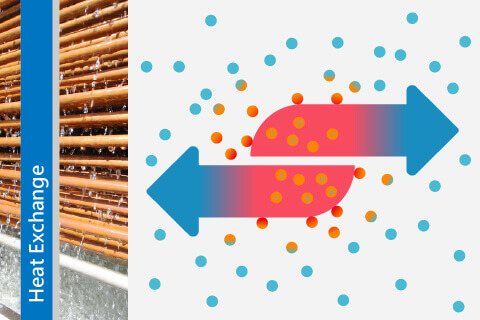
Ultra-High-Efficiency Heat Exchange Technology

Ensures stable operation even under extreme conditions, providing the most reliable cooling core for advanced industries.
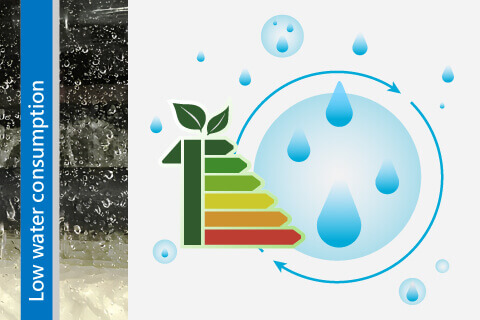
Environmental & Energy-Saving Advancements

Developing next-generation equipment with lower water and energy consumption to support enterprises in achieving carbon neutrality and ESG goals.
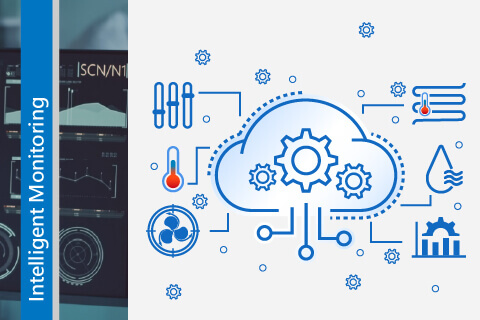
Intelligent Control & Remote Monitoring

Integrating smart energy-saving controls and remote diagnostics to enable early warnings and reduce the risk of unplanned downtime.

As the global movement toward ESG sustainability and industrial intelligence accelerates, the cooling industry is entering a new era of smart cooling.
Linkcooling will continue to lead with advanced technology and uncompromising quality, delivering cooling solutions that integrate high efficiency, intelligent control, and long-term sustainability —becoming a trusted foundation for stable growth across global manufacturing industries.

Linkcooling
The Preferred Choice of Industry Leaders

In the field of industrial cooling, choosing the right partner defines your operational efficiency and long-term competitiveness.

As a leading closed-circuit cooling tower brand in the international market, Linkcooling delivers high-efficiency, durable, and environmentally responsible cooling solutions—backed by CTI international certification and a proven record of 3,000+ successful installations worldwide—ensuring your equipment operates with consistent stability.

Linkcooling’s cooling systems are widely adopted across advanced manufacturing, technology sectors, and precision industries, ensuring stable and efficient production environments. Our clients include:

  • Advanced manufacturing (automotive, aerospace, precision machinery)

  • Electronics and semiconductor industries (wafer fabs, IC design companies)

  • Chemical and plastics industries (rubber & plastic molding, chemical production)

  • Medical and biotechnology sectors (medical equipment, pharmaceutical plants)

  • Data centers and server facilities (cloud computing, artificial intelligence applications)

These industries demand exceptional stability, durability, and environmental performance. With its advanced technology and comprehensive service, Linkcooling has earned the trust of leading companies worldwide.

Explore Industry Cases