


2017/03/03
Technology
Comparison of Crossflow and Counterflow Cooling Towers: Introduction to Water Flow Principles
Cooling towers are indispensable in industrial production, facilitating the dissipation of waste heat generated during manufacturing processes by exchanging heat between water and air. Among the various types of cooling towers, crossflow and counterflow are the most common. This article introduces the principles, features, and comparisons of these two types of cooling towers, along with an in-depth discussion on the principles of water flow.
Principles of Cooling Towers
The working principle of a cooling tower involves the heat exchange between water and air, enabling the release of waste heat from industrial processes into the atmosphere. Water is pumped to the top of the tower and evenly distributed over heat-dissipating fills through spray nozzles. As water flows over the fills, it comes into contact with air, transferring heat to the air and thereby absorbing a significant amount of heat. The cooled water then collects in a basin and is recirculated back into the cooling system.
Crossflow Cooling Tower Principles
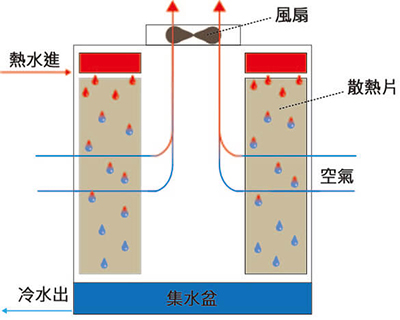
In a crossflow cooling tower, water flows downward while air is blown horizontally. The perpendicular intersection of water and air flows creates a large heat exchange area, enhancing cooling efficiency. Due to the horizontal air intake, the distance between the heat-dissipating fills and the water basin is minimal, which reduces water drop noise. Typically used in square cooling towers, the design's reliance on extensive iron supports and fixtures results in higher construction costs compared to traditional round cooling towers.
Advantages
- Simple design
- Easy maintenance
- Low water pressure
- Low noise levels
- Small footprint
Disadvantages
- Slightly lower cooling efficiency compared to counterflow cooling towers
Counterflow Cooling Tower Principles
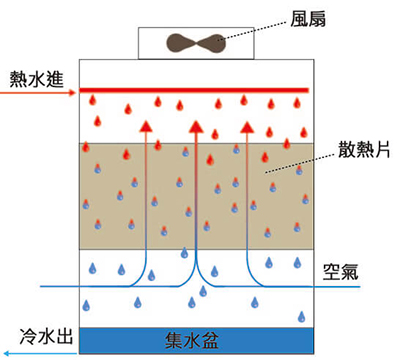
In a counterflow cooling tower, cooling air and water flow in opposite directions. This counterflow maximizes the heat exchange area, prolongs the contact time between air and water, and enhances cooling efficiency. However, it requires numerous air inlets, resulting in a greater height for the fills and basin. This design is common in traditional round cooling towers but is also found in square designs.
Advantages
- High cooling efficiency
Disadvantages
- Complex internal structure
- Difficult maintenance
- Prone to scale formation
- Higher splash losses
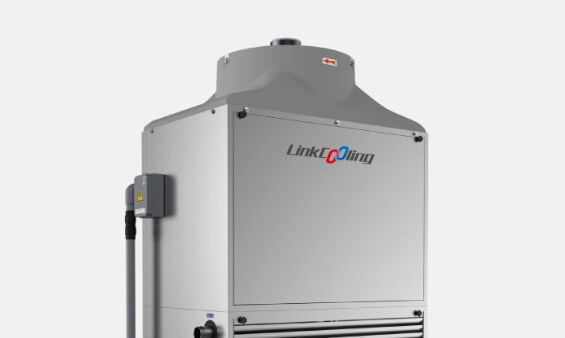
Linkcooling Hybrid Closed-Circuit Cooling Towers
Linkcooling hybrid closed-circuit cooling towers combine the advantages of crossflow and counterflow designs. They feature a same-direction airflow design and crossflow setup, effectively reducing splash losses while maintaining noise-free operation. Additionally, these towers utilize environmentally-friendly 304 stainless steel shells and coils, providing durability, aesthetics, and resistance to scale issues.
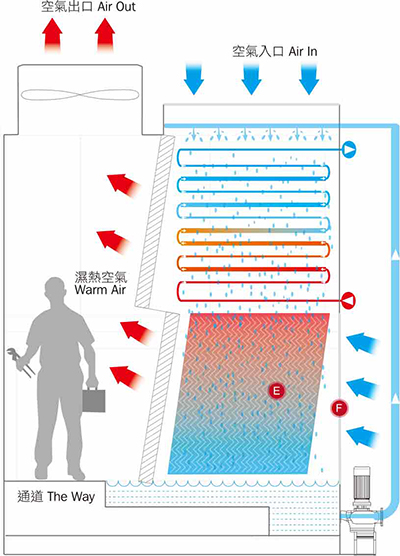
Linkcooling Hybrid Closed-Circuit Cooling Tower Advantages
- Eliminates scale problems
- #304 stainless steel eco-friendly shell and coils (optional aluminized zinc version)
- Same-direction airflow design combined with crossflow setup
- Low splash losses
- Large maintenance space
Selecting the appropriate cooling tower requires consideration of several factors, including cooling efficiency, maintenance costs, operational noise, and equipment lifespan. While crossflow and counterflow cooling towers each have their advantages and disadvantages, the Linkcooling hybrid closed-circuit cooling tower integrates the benefits of both, offering an efficient, reliable, and low-maintenance solution. This makes Linkcooling hybrid closed-circuit cooling towers the optimal choice in the field of process cooling.