

2016/11/24
Environmental Knowledge
The Impact of Limescale on Heat Exchange and Power Consumption
The presence of limescale in cooling systems can significantly interfere with heat exchange processes, leading to increased power consumption and reduced efficiency. This document, based on the Bureau of Energy, Ministry of Economic Affairs' 2012 Power Industrial Technical Proposal, outlines the effects of limescale on power consumption and heat exchange rates in industrial cooling systems.
Key Findings
Limescale Buildup on Condenser Tubes
- A 1℃ rise in the temperature of the cold medium results in a 3% increase in power consumption.
- Insufficient cooling water for the condenser (<85%) leads to a 3% increase in power consumption.
- A 1℃ rise in the cooling tower's heat dissipation temperature results in a 2% increase in power consumption.
Effect of Limescale Thickness on Power and Fuel Consumption
Limescale affect power consumption
| Thickness of limescale (mm) | Fuel consumption (%) | Cooling capacity (%) | Electrical power consumption (%) |
|---|---|---|---|
| 0.2mm | Increase 6% | Decrease 95% | Increase 7~17% |
| 0.4mm | Increase 15% | Decrease 84% | Increase 16~26% |
| 0.6mm | Increase 25% | Decrease 76% | Increase 23~34% |
| 0.8mm | Increase 32% | Decrease 72% | Increase 31~41% |
Reference: China Trchnical Consultants, Inc
Effect of Limescale Thickness on Heat Exchange
Limescale affect heat exchange
| Thickness of limescale (mm) | Heat exchange level (BTU/ft2/F) | Heat transfer consumption (%) | Electrical power consumption |
|---|---|---|---|
| 0 | 92.77 | 0 | 0 |
| 0.3mm | 73.68 | 21% | 10% |
| 0.6mm | 61.12 | 34% | 20% |
| 0.9mm | 52.20 | 44% | 31% |
| 1.2mm | 45.60 | 56% | 42% |
| 1.6mm | 39.52 | 67% | 53% |
Reference: Phillip Kote Clean System Approach to Air Conditioning Heating Piping Air Conditioning Journal
The Growth of Limescale Over Time
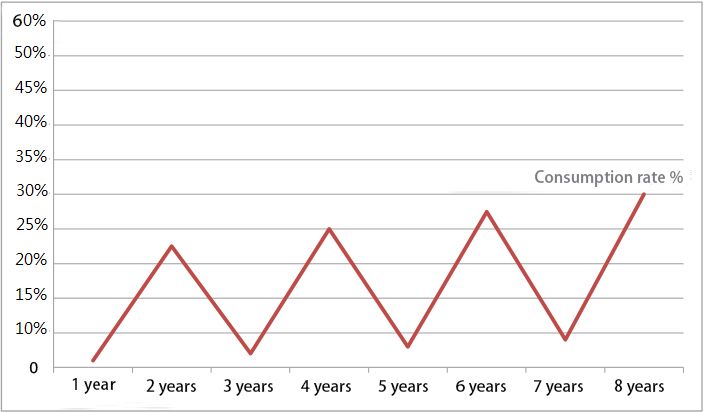
Limescale buildup increases with prolonged cooling time, which necessitates regular maintenance and cleaning of cooling systems to prevent significant efficiency losses and increased energy costs.
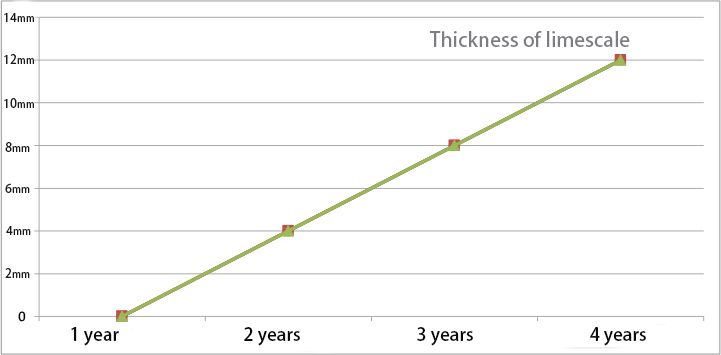
PS: The above chart is the default value. Limescale speed is based on the actual environment.
Open vs. Closed Cooling Circuits
Open Cooling Circuit :
- Regular limescale cleaning is essential but only provides temporary improvements.
- Uneven limescale buildup can lead to reduced cooling efficiency and increased power consumption over time.
- The complexity of water circuits makes it difficult to achieve thorough cleaning, potentially causing long-term damage to metal tubes.
Closed Cooling Circuit :
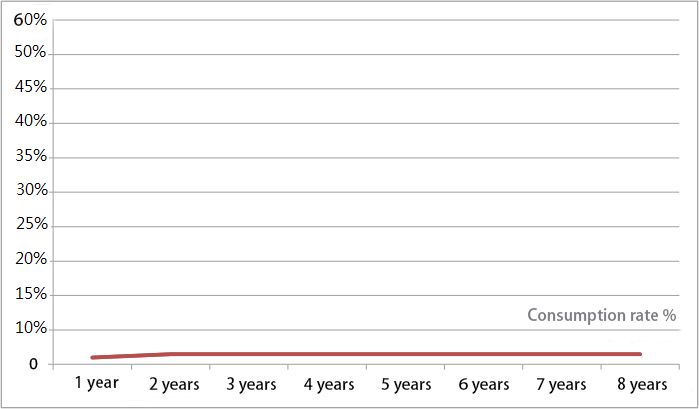
- Limits the concentration of impurities, preventing limescale formation.
- Maintains consistent cooling efficiency and reduces the need for frequent cleaning.
- Protects metal tubes from damage and extends the lifespan of the cooling system.
Understanding and Utilizing Closed Circuit Cooling Towers
A closed circuit cooling tower isolates external impurities from the cooling system, maintaining clean cooling water and stable temperatures. This system:- Separates the cooling water into an internal and external circuit.
- Uses an external pump to spray water onto the internal heat exchanger, indirectly cooling the internal circuit.
- Prevents dirt and limescale from entering and forming in the cooling system, enhancing overall efficiency.
For more information on closed circuit cooling towers, including their design, structure, and benefits, as well as the technical details of Linkcooling's cooling tower products, please contact our professional engineers.