2026/07/24
Plastic Processing
Cooling System Upgrade for Precision Plastic Injection Molding
- Project Overview
- Project Background
- Customer Challenges
- Why the Customer Chose Linkcooling Closed Circuit Cooling Towers
- How Linkcooling Closed Circuit Cooling Towers Were Applied
- Parallel Installation to Minimize Production Downtime
- Project Results
- Before & After Comparison
- Key Takeaways
- Featured Product
- Technical Support
- Frequently Asked Questions (FAQ)
Upgrading from Open Cooling Towers to Closed Circuit Cooling Towers: A Cooling System Modernization Case for a Precision Electronics Components Manufacturer.
As plastic injection molded products continue to evolve toward higher precision and smaller form factors, cooling systems must do more than provide reliable heat rejection. They also need to support stable production processes, simplify maintenance, and ensure long-term operational reliability. However, while products, molds, and manufacturing processes continue to evolve, many factories still operate cooling systems designed for their original production requirements. As a result, equipment capacity, process water management, and overall system architecture may no longer align with current operational needs.
This case study highlights how a precision electronics components manufacturer in Taiwan upgraded its cooling system to better support changing production requirements. Facing changing process requirements, increasing water quality management challenges, and ongoing maintenance issues, the customer reassessed its cooling infrastructure and selected Linkcooling Closed Circuit Cooling Towers. The upgraded system was designed to better match current production requirements, while the system changeover was completed within two days to help minimize disruption to the production schedule.
Project Overview
| Category | Details |
|---|---|
| Industry | Precision Plastic Injection Molding |
| Application | Electronic Products and USB Components |
| Location | Taipei, Taiwan |
| Production Equipment | 15 Plastic Injection Molding Machines |
| Original Cooling System | Four Open Cooling Towers |
| Upgraded Cooling System | Two Linkcooling SCT-30 Closed Circuit Cooling Towers |
| Implementation Strategy | Parallel Installation of the New and Existing Systems |
| System Changeover | Completed in 2 Days |
Project Background
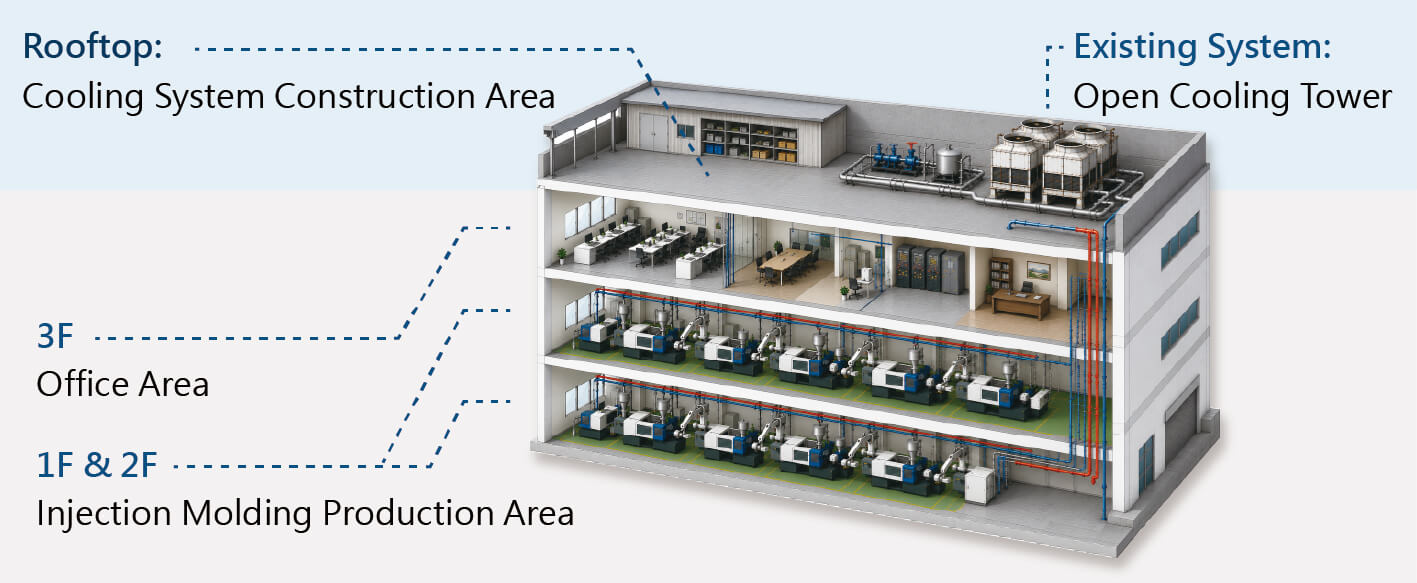
The customer is a Taiwan-based contract manufacturer that has evolved alongside the electronics industry. Originally focused on telephone and mobile phone products, the company has gradually expanded into the production of USB products and other precision electronic components.
The facility operates 15 plastic injection molding machines located on the first and second floors, while the cooling equipment is installed on the rooftop. The original cooling system consisted of four open cooling towers that had been supporting production for many years.
As product designs, molds, and production processes continued to evolve, the customer began reassessing whether the existing cooling system could still meet current production requirements. Beyond replacing aging equipment, the project aimed to improve process water management, optimize equipment layout, simplify maintenance, and create a more stable and manageable cooling system.
Customer Challenges
When reassessing the cooling system, the customer was not simply replacing aging equipment. The primary objective was to address a series of operational and system management challenges that had developed over years of production.
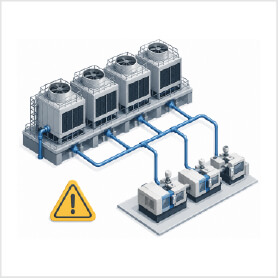
Cooling System Configuration No Longer Matched Current Production Requirements
As the factory transitioned from communication products to precision electronic components, operating conditions and cooling requirements changed significantly. However, the original cooling system configuration remained largely unchanged, resulting in a mismatch between the existing system capacity and current production requirements.
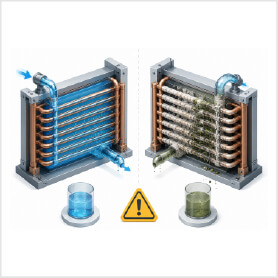
Open Cooling Towers Increased Process Water Management Challenges
The original open cooling towers were initially designed to serve both the air conditioning system and the plastic injection molding process. After the air conditioning system was removed, the remaining cooling capacity exceeded actual production requirements. This oversized system increased water loss through evaporation and drift while making circulating water temperatures more susceptible to seasonal fluctuations.
In addition, because process water in an open cooling tower is continuously exposed to the surrounding environment, contaminants such as dust, algae, and airborne particles gradually accumulated within the system. Over time, calcium carbonate (CaCO₃) scale formed on heat transfer surfaces, reducing heat exchange efficiency and increasing maintenance requirements for the circulating water system.
For plastic injection molding applications, process water directly supports mold cooling circuits, oil coolers, and mold temperature controllers. When water quality deteriorates or circulating water temperatures become unstable, maintaining consistent mold temperatures becomes more difficult. This can increase variations in dimensional accuracy, shrinkage, and molding consistency for precision USB components, while also increasing maintenance requirements for molds and cooling equipment.
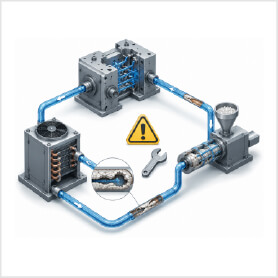
Increasing Maintenance Challenges for Injection Molding Equipment
Over years of operation, the open cooling tower system experienced gradual deterioration in process water quality, while calcium carbonate (CaCO₃) scale continued to accumulate throughout the cooling circuit. As a result, deposits increasingly restricted the flow of cooling water through critical components, including oil coolers, mold cooling channels, and barrel water jackets.
Reduced cooling performance in the barrel water jacket increased the temperature at the feed section, causing plastic pellets to soften prematurely before entering the barrel. This could lead to material bridging, unstable feeding, and unplanned production interruptions, while increasing the need for equipment cleaning and maintenance. At the same time, reduced mold cooling efficiency made mold temperature control more difficult, increasing the risk of dimensional variation and inconsistent molding quality. For precision injection molding operations, the primary concern was not the cooling tower itself, but the cascading effects that declining cooling system performance had on the overall molding process.
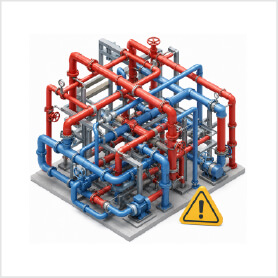
Complex Equipment Layout and Piping Configuration
The original cooling system shared portions of its piping network with the fire protection system. As production equipment was expanded over time, the piping layout and overall system configuration became increasingly complex, reducing maintenance efficiency and limiting flexibility for future system upgrades.
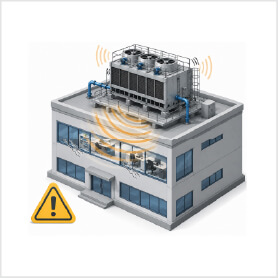
Noise Impact on the Working Environment
Continuous operation of the rooftop cooling equipment generated noise that gradually affected the adjacent office environment. During the cooling system upgrade, improving the operating environment through lower equipment noise was also one of the customer's key objectives.
Why the Customer Chose Linkcooling Closed Circuit Cooling Towers
Rather than simply replacing the existing equipment with units of the same specification, the customer sought a cooling solution that better matched current production requirements. Before selecting new equipment, the project team reassessed the operating conditions of the facility, including the actual cooling requirements of the 15 plastic injection molding machines, the existing piping layout, and the available installation space. These findings formed the basis for selecting the appropriate cooling tower specification.
The assessment showed that the facility's actual heat load had changed significantly since the plant was originally commissioned. As a result, the original system capacity and equipment quantity were no longer the optimal configuration. Simply replacing the existing equipment with the same specifications would not have resolved the underlying system management issues or improved long-term maintenance efficiency.
After evaluating heat load, equipment layout, process water management, and installation constraints, the customer selected two Linkcooling SCT-30 Closed Circuit Cooling Towers to replace the four existing open cooling towers, establishing a cooling system that was better aligned with the facility's current operating requirements.
How Linkcooling Closed Circuit Cooling Towers Were Applied
The project involved more than replacing the cooling towers. It included reconfiguring the cooling equipment, piping layout, and system management approach to fully leverage the advantages of a closed circuit cooling system.
-
Reconfigured Equipment Capacity to Match Actual Cooling Requirements
After reassessing the facility's actual cooling requirements, the new equipment configuration was resized and reconfigured to better match current production conditions rather than simply following the original system design. This ensured that the cooling capacity was appropriately aligned with the facility's process requirements. -
Improved Process Water Management
The closed circuit cooling towers employ a sealed heat exchange design that isolates the process water from the surrounding environment. By reducing exposure to dust, airborne debris, and other contaminants, the system helps minimize scale formation and supports more consistent process water quality, while also reducing long-term maintenance requirements. -
Optimized Equipment Layout for Easier Maintenance
As part of the new system layout, the rooftop equipment area was reorganized to create a more efficient equipment arrangement. The new configuration consolidated previously scattered equipment and eliminated the long-term effects of water spray on the equipment platform, while providing easier access for routine inspection, servicing, and maintenance. -
Simplified the Cooling System Architecture
As part of the upgrade, the cooling system was reconfigured and separated from the fire protection system. This simplified the existing piping network, improved overall system management, and provided greater flexibility for future equipment expansion and maintenance.
Parallel Installation to Minimize Disruption to Production
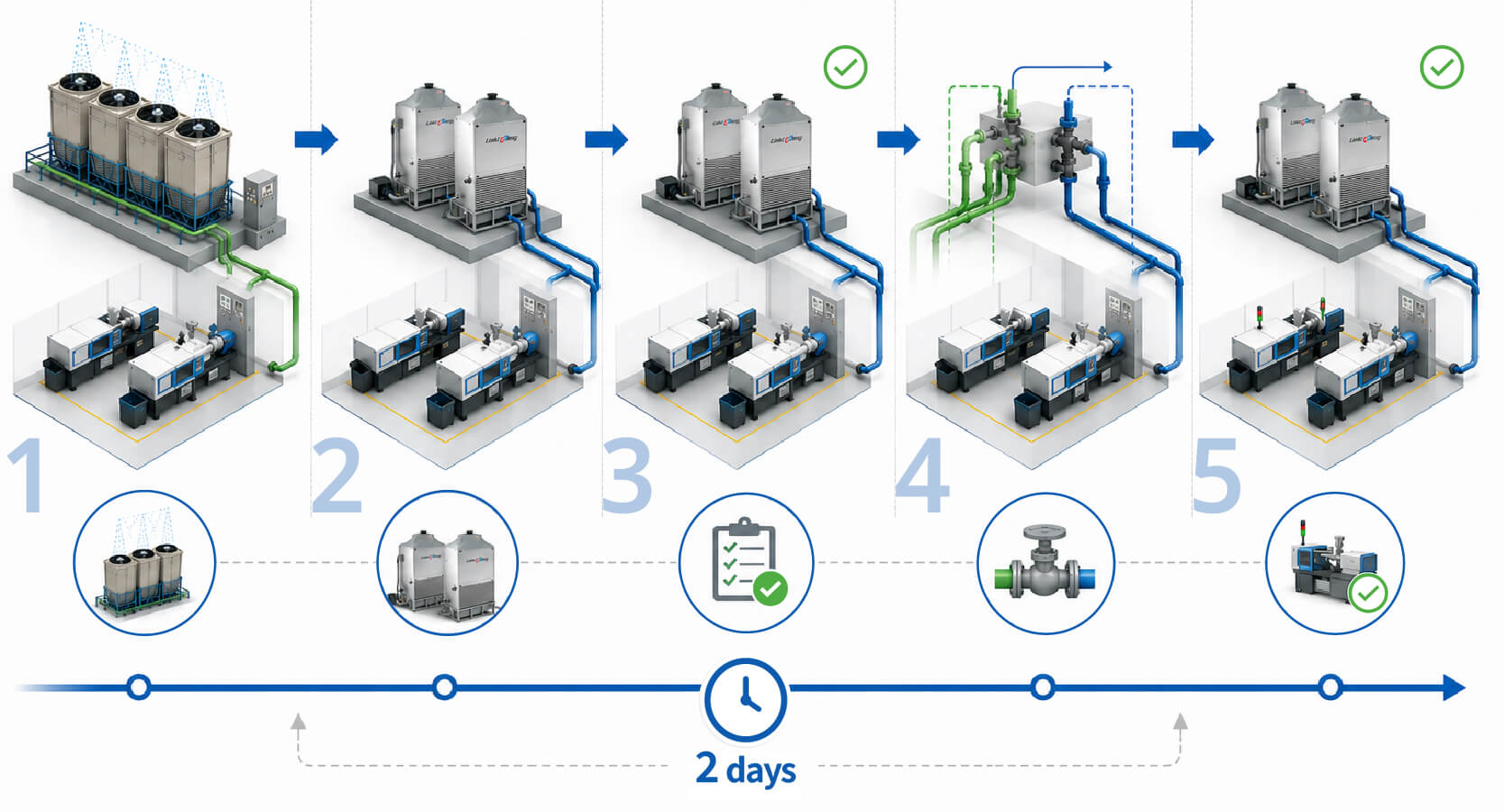
For manufacturing facilities operating continuous production, the greatest challenge in equipment replacement is often not the installation itself, but minimizing disruption to production during system changeover.
Because extended production shutdowns were not feasible, Linkcooling completed the site survey, piping design, and changeover planning before construction began. The available rooftop space enabled the new cooling system to be installed alongside the existing equipment, allowing the majority of the installation work to be completed before the final system switchover.
The new system was pre-assembled and factory-tested prior to delivery, reducing the amount of on-site work required during the final changeover. After completing the piping connections, functional verification, and commissioning, the cooling system was successfully switched over within two days, minimizing disruption to the customer's production schedule.
Project Results
Following the equipment upgrade and system changeover, the new cooling system was successfully commissioned and placed into production. Beyond achieving the project objectives, the upgrade also addressed several long-standing challenges related to system management, maintenance, and the operating environment.
Cooling Capacity Better Aligned with Current Production Requirements
Following a reassessment of the facility's cooling requirements, the cooling system was resized to better support current production conditions. By replacing the original plant design with a configuration based on actual operating requirements, the installed cooling capacity is now better aligned with the facility's process needs.
Improved Process Water Management
By isolating process water from the surrounding environment, the closed circuit cooling towers help minimize scale buildup commonly associated with open cooling tower systems. As a result, the frequency of cleaning and maintenance is reduced, supporting more efficient cooling system management over the long term.
Simplified Cooling System Management
The cooling system was separated from the fire protection system, resulting in a clearer piping layout and a more streamlined system architecture. This simplified configuration improves accessibility for routine inspection, maintenance, and long-term system management.
Optimized Equipment Layout and Working Environment
The equipment layout within the rooftop equipment area was optimized, reducing the long-term maintenance burden associated with continuous water spray on the existing elevated platform. The use of low-noise 8-pole fan motors also reduced operating noise, contributing to a quieter and more comfortable working environment for the adjacent office area.
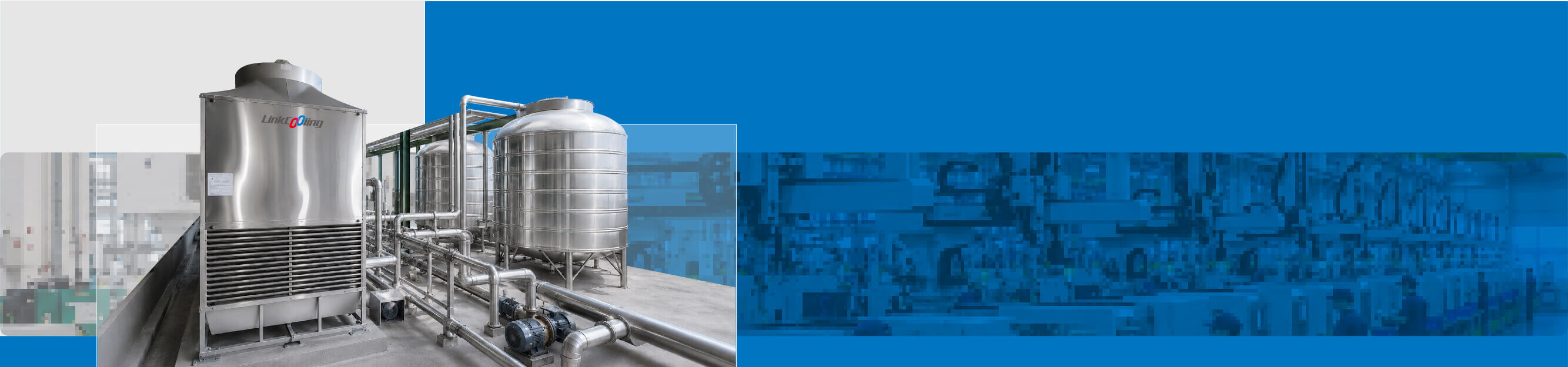
Completed Installation
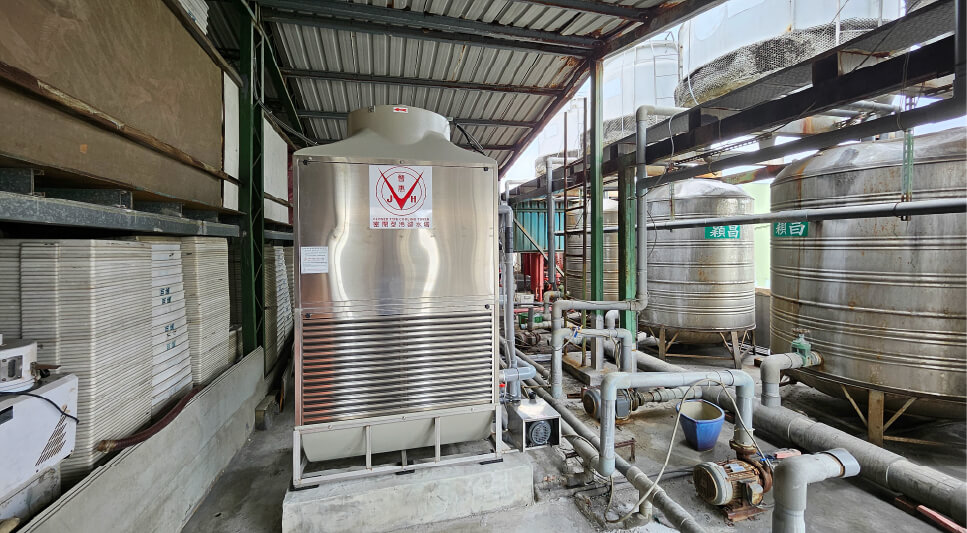
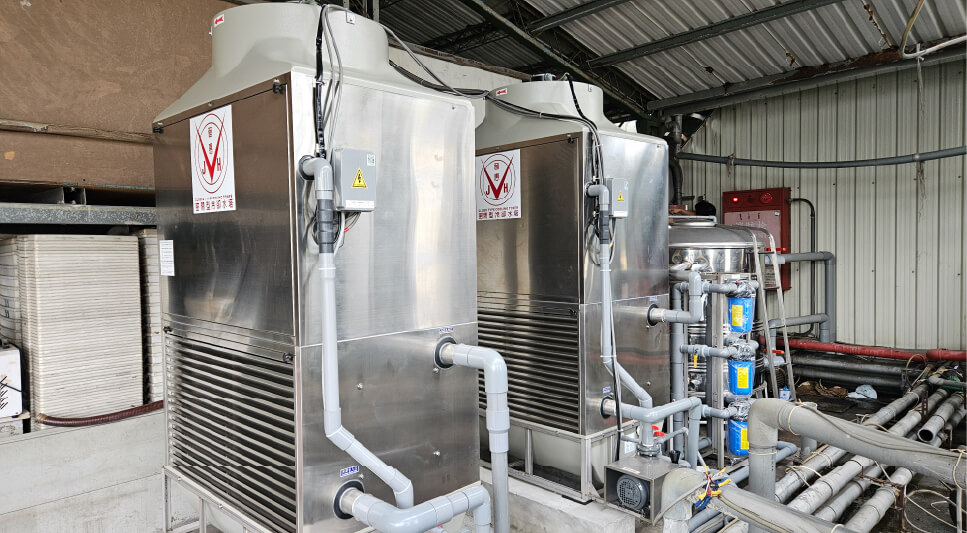
Before & After Comparison
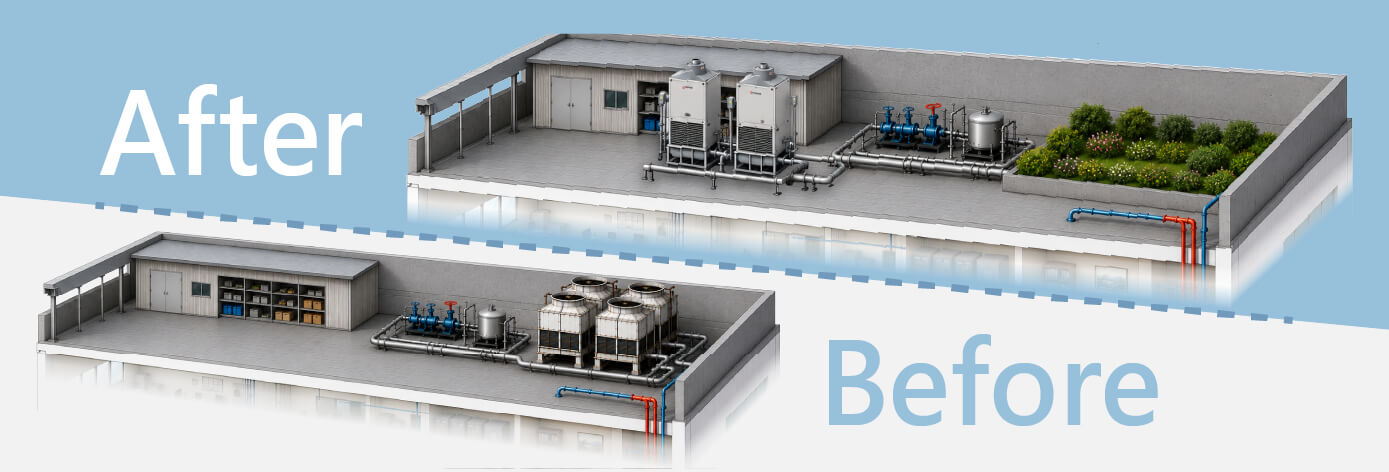
| Evaluation Item | Before | After |
|---|---|---|
| Cooling Equipment | Four open cooling towers | Two Linkcooling SCT-30 closed circuit cooling towers |
| Cooling System Design | Original system no longer matched current process heat load | Cooling capacity recalculated and resized to match current process requirements |
| Process Water Management | Process water exposed to external contaminants, resulting in scale buildup | Closed-loop heat exchange helps maintain cleaner process water and reduces scale formation |
| System Configuration | Cooling and fire protection systems shared the same piping network | Cooling and fire protection systems operate independently with a simplified piping layout |
| Equipment Layout | Larger equipment footprint; continuous water spray increased platform maintenance | More compact equipment layout with reduced maintenance requirements for the equipment platform |
| Noise & Working Environment | Operating noise and vibration affected the adjacent office area | Low-noise 8-pole fan motors significantly reduced operating noise |
| Installation & Changeover | Conventional replacement required equipment removal before installation, increasing production downtime risk | Standardized pre-assembled design simplified piping connections, enabling system changeover within two days |
Key Takeaways
Manufacturing processes, production equipment, and operating conditions naturally evolve over time. As these changes occur, it is important to periodically reassess whether the existing cooling system continues to meet current operating requirements.
This project demonstrates that upgrading a cooling system does not necessarily require increasing cooling capacity. More importantly, it provides an opportunity to verify whether the equipment is properly sized for current process requirements while supporting long-term considerations such as process water management, maintenance accessibility, and future expansion.
For OEM equipment manufacturers, system integrators (SIs), and facility engineers, closed circuit cooling towers can serve not only as an effective solution for equipment replacement, but also as a valuable option when designing new production lines or planning new manufacturing facilities. Although this project was completed in Taiwan, the engineering approach to equipment selection, heat load assessment, and system integration provides practical reference for cooling system planning across a wide range of industrial applications.
When planning a cooling system for injection molding applications, cooling capacity is only one part of the overall design. The following considerations can help guide equipment selection and system planning:
- Reassess the actual heat load based on current production requirements rather than relying on the original equipment capacity.
- Consider both process water management and long-term heat exchange performance to support stable system operation.
- Simplify the piping layout where possible to improve accessibility for future inspection and maintenance.
- Select equipment based on installation space, operating environment, and future expansion requirements.
In modern manufacturing, cooling equipment is more than a heat rejection device—it is an integral part of the overall production system. Through proper equipment selection and system integration based on actual operating requirements, manufacturers can build cooling systems that are more reliable, easier to maintain, and better suited to long-term production needs.
Featured Product
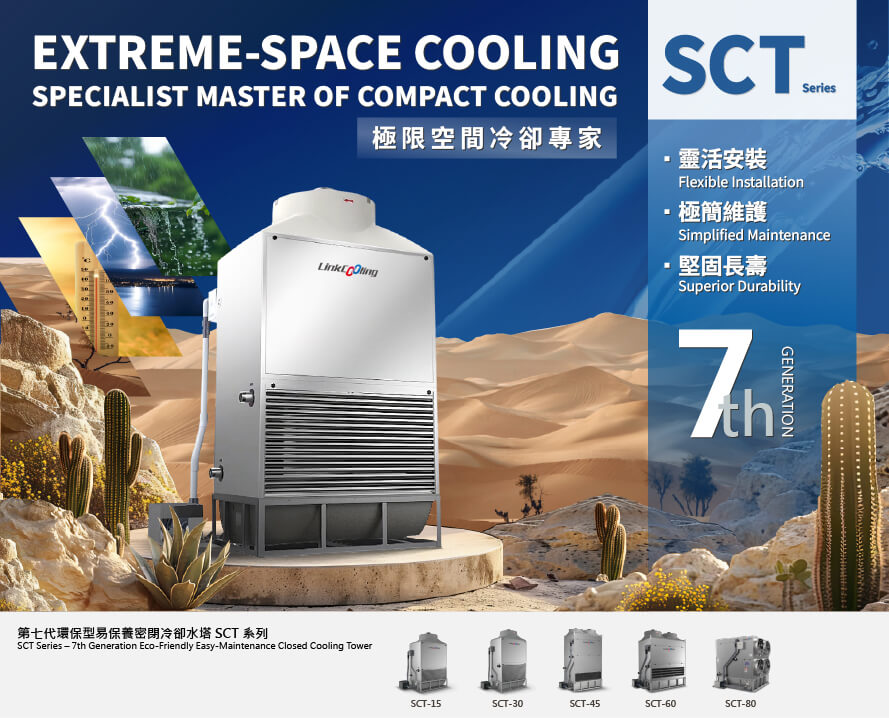
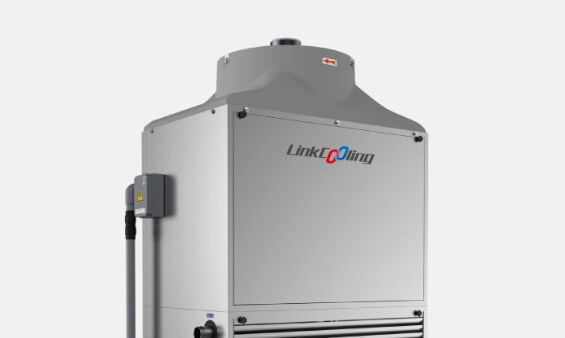
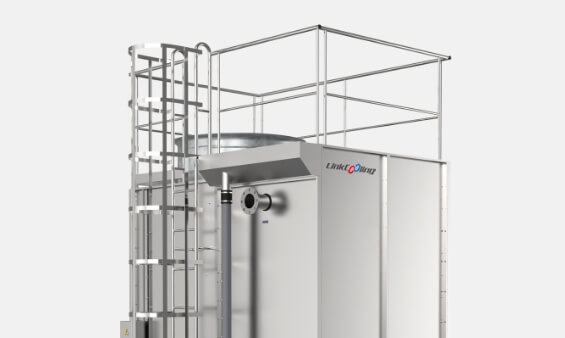
Linkcooling SCT-30 Closed Circuit Cooling Tower
The SCT-30 is a closed circuit cooling tower designed for industrial process cooling and OEM equipment integration. It is well suited for applications including plastic injection molding, industrial chillers, air compressors, and induction heating systems.
Multiple SCT-30 units can be operated in parallel, allowing cooling capacity to be expanded as application requirements evolve. Available with a #304 stainless steel casing, high-efficiency heat exchange coils, and low-noise 8-pole fan motors, the SCT-30 delivers reliable cooling performance while supporting long-term equipment reliability and simplified maintenance.
Learn More About the Linkcooling SCT-30
Key Features
- Closed-loop heat exchange design to reduce process water contamination.
- Modular configuration for flexible application and capacity planning.
- Supports parallel operation for future system expansion.
- Equipped with low-noise 8-pole fan motors for reliable cooling performance and reduced operating noise.
- Ideal for OEM equipment integration and a wide range of industrial process cooling applications.
Designed for Global OEM Applications
-
Export-Ready Design
The SCT-30 is engineered with international equipment manufacturers in mind. Its compact footprint is optimized for standard container shipping, while configurable motors and electrical options support regional compliance requirements, making integration into OEM equipment and industrial cooling systems more efficient. -
Modular Design for Simplified Installation
Each unit is delivered with a high level of factory pre-assembly, with more than 90% of assembly and testing completed before shipment. The modular enclosure design minimizes on-site installation work, reducing construction uncertainty and shortening project schedules.
Particularly suited for international projects, installation is limited primarily to process piping and electrical power connections. This significantly reduces overseas installation and system integration time, enabling customers to commission their equipment and resume production more quickly. -
Designed for Global OEM Integration
The SCT-30 can be configured with CE- or UL-compliant motors and electrical components to meet the requirements of different international markets.
These configurable options simplify integration for OEM equipment manufacturers and system integrators. Once delivered, the cooling tower can be integrated directly into the OEM's control system, reducing additional engineering work and supporting faster deployment in global equipment applications.
Technical Specifications
| Parameter | Specification |
|---|---|
| Cooling Capacity |
90,000 kcal/h (104.6 kW) (Based on 38°C entering water, 33°C leaving water, 27°C ambient wet-bulb temperature) |
| Heat Exchange Coil | #304 stainless steel coil |
| Water Flow | 300 L/min |
| Inlet/Outlet Water Pipe | 2-½" |
| Spray Pump | 1 HP |
|
Water Supply Pipe (Rapid Supply) |
½" |
| Fan Motor | 3Φ/8P/0.75×1 kW×pcs |
| Fan Blade | 28"×1 inch×pcs |
| Fan Air Volume | 11500 m³/hr |
| Net Weight | 400 kg |
| Dimensions (L×W×H) | 1750×950×2500 mm |
| Casing Material | Fully Detachable SUS 304 Stainless Steel |
| Fill Media | Reusable Impact-Resistant ABS Fill |
| System Design | Supports Parallel Operation with Multiple Units and Models |
| Electrical Compliance Options | Optional CE-Compliant Motor and Electrical Components |
Specification Note: For international projects, the 304 stainless steel coil is recommended to enhance long-term reliability during overseas transportation, accommodate varying site water conditions, and support lower maintenance requirements throughout the service life.
Technical Support
Whether you are planning a new cooling system for plastic injection molding or evaluating an upgrade to an existing installation, Linkcooling provides equipment selection guidance, technical documentation, and engineering support for closed circuit cooling towers. We help OEM equipment manufacturers, system integrators, and industrial end users select the right cooling solution based on actual heat load requirements and site installation conditions.
-
Taiwan Projects
We provide cooling system planning, equipment supply, installation, and commissioning services. -
International Projects
We focus on supplying closed circuit cooling towers, supported by product specifications, technical documentation, and equipment selection assistance to help local OEM partners and system integrators complete equipment integration efficiently.
Frequently Asked Questions (FAQ)
Q1. How do closed circuit cooling towers reduce the risk of scale buildup in precision injection molds?
Closed circuit cooling towers use a sealed heat exchange system that separates the process water circuit from the external spray water circuit. The process water flowing through the precision molds circulates entirely within the closed heat exchange coil, isolated from ambient air and external contaminants. This design helps minimize the entry of airborne particles and impurities into the process water, reducing the risk of scale buildup inside the cooling circuit and supporting more stable cooling performance over the long term.
Q2. Can Linkcooling closed circuit cooling towers help reduce international shipping and installation costs?
Yes. Linkcooling designs its products with the logistical requirements of international markets in mind. The SCT-30 features a compact footprint optimized for standard 20-foot and 40-foot shipping containers, helping maximize container utilization and reduce international freight costs.
In addition, each unit is delivered with a high level of factory pre-assembly and a modular design, with most assembly and testing completed before shipment. Overseas installation is typically limited to process piping and electrical power connections, helping shorten on-site installation time while reducing overseas installation and system integration costs.
Q3. When should an open cooling tower be upgraded to a closed circuit cooling tower?
An upgrade should be considered when the existing cooling system experiences frequent scale buildup, increasing maintenance requirements, difficulty maintaining water quality, or when changes in production processes mean the original cooling system no longer meets current operating requirements.
In addition to improving process water management, closed circuit cooling towers help enhance equipment reliability, reduce maintenance requirements, and provide a more stable cooling environment for long-term operation.
Q4. Does upgrading to a closed circuit cooling tower always require a complete cooling system redesign?
Not necessarily.
Whether a complete system redesign is required depends on the condition of the existing equipment, the piping configuration, and the process cooling requirements. In this project, part of the existing vertical piping was retained, while the equipment layout and piping configuration were optimized to modernize the cooling system with minimal disruption to production.
With a thorough engineering assessment, existing equipment that remains suitable for service can often be retained, helping improve upgrade efficiency while reducing unnecessary modifications.
Q5. What are the advantages of installing the new cooling system alongside the existing system?
For manufacturing facilities operating continuous production, production downtime often represents a greater cost than the equipment replacement itself. Installing the new cooling system alongside the existing system allows most installation and testing to be completed before the final system changeover, helping minimize production downtime and reduce the impact on production schedules and delivery commitments.
This approach is not suitable for every project and should be evaluated based on the available installation space and existing site conditions.
Q6. Can OEM equipment manufacturers or system integrators partner with Linkcooling?
Yes.
Linkcooling works closely with OEM equipment manufacturers and system integrators to provide closed circuit cooling tower selection, application engineering support, and integration assistance tailored to specific equipment and process cooling requirements.
For international markets, we supply closed circuit cooling towers together with product selection guidance, engineering documentation, CAD drawings, and technical support to facilitate equipment integration. In Taiwan, we additionally provide cooling system planning, equipment installation, commissioning, and after-sales service.
Q7. How does Linkcooling help customers select the right closed circuit cooling tower?
Every industry, manufacturing process, and application has unique cooling requirements, so there is no one-size-fits-all solution.
Rather than simply replacing existing equipment based on its installed capacity, Linkcooling evaluates each application individually by considering factors such as process cooling requirements, equipment configuration, available installation space, and long-term maintenance considerations. Based on this assessment, we recommend the closed circuit cooling tower that best fits the customer's operating requirements.
Accelerate Your Equipment Integration with Dedicated Engineering Support
Linkcooling specializes in the design and manufacture of closed circuit cooling towers, providing OEM equipment manufacturers, system integrators (SIs), distributors, and industrial end users with product selection guidance, application engineering support, and engineering documentation to help streamline equipment integration.
Whether you are developing next-generation OEM equipment, upgrading an existing cooling system, or selecting a closed circuit cooling tower for applications such as plastic injection molding, industrial chillers, air compressors, or induction heating systems, our engineering team can recommend the most suitable solution based on your specific application requirements and provide the technical support needed to ensure successful integration.
Linkcooling Engineering Support
-
For Design & Engineering Teams
We provide dimension drawings, CAD files, and engineering documentation to support equipment integration, piping design, and structural planning. -
For OEM Equipment Manufacturers & System Integrators (SIs)
Based on your equipment heat load, application requirements, and installation conditions, we provide closed circuit cooling tower selection guidance, application engineering support, and technical evaluation to help identify the most suitable solution. -
For Procurement & International Logistics Teams
We provide 20-foot and 40-foot container loading guidance, product packaging information, and international shipping support, including FOB and CIF arrangements, to help streamline global logistics and equipment integration.
Whether your project is located in Taiwan or overseas, Linkcooling provides closed circuit cooling towers, engineering documentation, and technical support tailored to your application requirements. Our goal is to help accelerate equipment development, simplify system integration, and build reliable industrial cooling systems for long-term operation.
Contact Linkcooling
Whether you are developing new OEM equipment, upgrading an existing cooling system, or evaluating a cooling solution for your industrial application, our engineering team is ready to help.